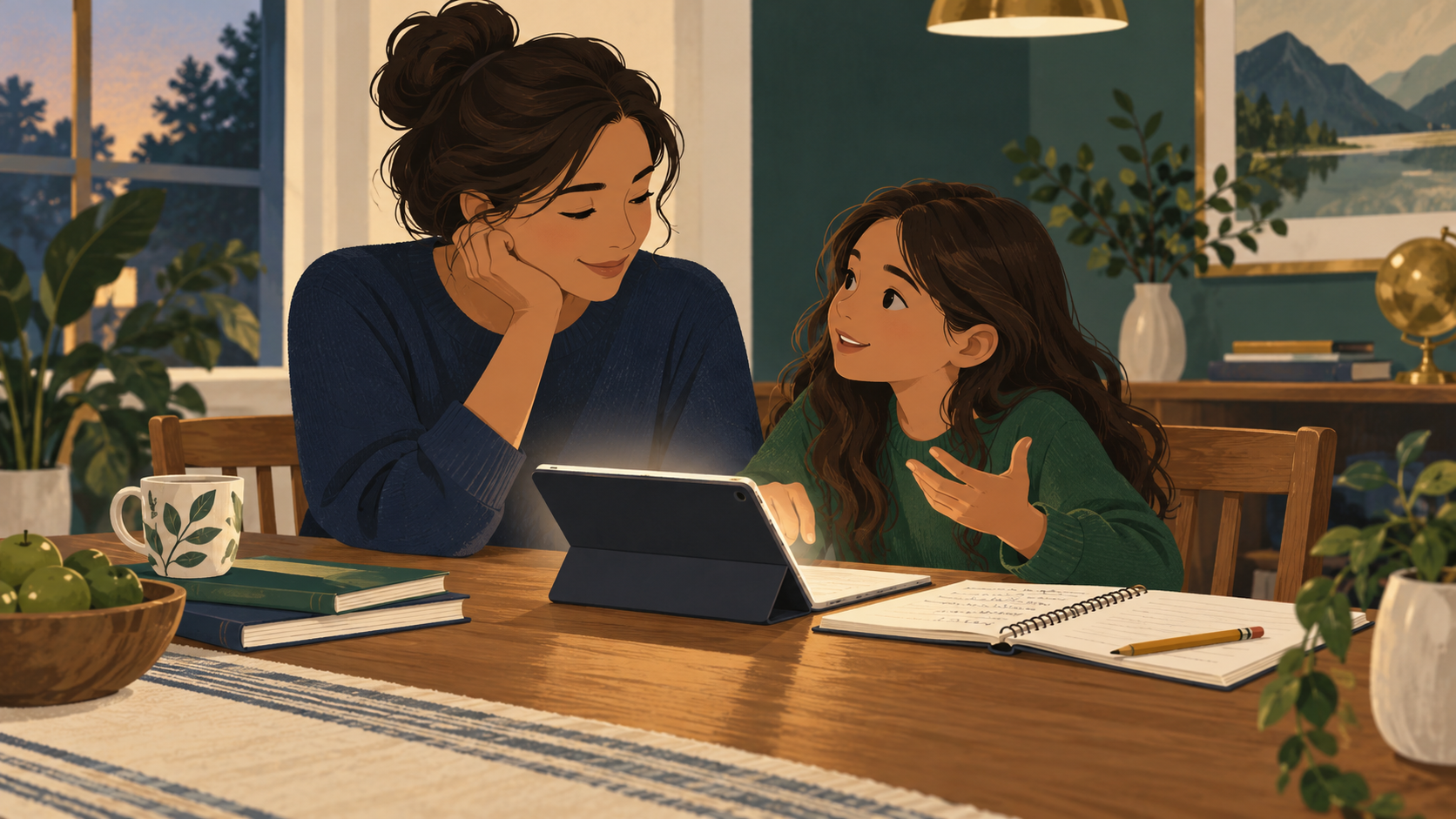
In this house, no answer from AI is complete until the person using it can explain it, question it, and decide what to do with it.
Every family needs a rule for the new machine in the room. Not a hundred rules. One rule that works when the homework changes, when the model gets smarter, when a child is tired, and when a parent is busy.
Here is the one worth keeping: no answer from AI is complete until the person using it can explain it.
That sentence does not turn AI into an enemy. It gives the tool its proper job. A calculator can check arithmetic. A map can show a route. AI can offer a first pass, a counterargument, a translation, a plan, or a question you had not considered. The human being still has to make sense of it.
The danger is not the answer
The danger is the tiny handoff that happens after the answer arrives. A child sees fluent words on a screen and feels the work is done. The parent sees a finished assignment and feels relieved. Everybody moves on. What disappeared was the part that builds capability: sorting truth from confidence, connecting a claim to what you already know, and finding the place where the answer does not hold together.
AI is very good at sounding settled. That makes it useful and makes it dangerous. A polished paragraph can be wrong. A confident recommendation can miss the local fact that changes everything. A kind answer can quietly flatter the person asking. The screen has no stake in whether your child develops judgment. Your family does.
Try this at dinner tonight
Ask each person to bring one answer they received from a tool, a teacher, a video, or a search result. Then ask three questions: What is it claiming? How would we check it? What would change your mind?
Explanation is the proof of possession
A child does not own an idea because they can paste it into a document. They own it when they can put it in their own words, carry it into a new situation, and defend it against a fair question.
This is the old standard. It was true before AI. It will be true when the next system is ten times better. The technology only makes the standard visible again because borrowed fluency is now cheap.
When your daughter asks AI to help with a history paper, the rule is not, "Never use it." The rule is, "Tell me what it said, tell me why it matters, and tell me which part you are least sure about." When your son asks for a business idea, do the same. Let him use the machine, then make him bring his own mind back into the room.
Make the rule practical
Put the rule beside the place where schoolwork happens. Use it without a speech. The less theatrical it is, the better.
For younger children, ask them to teach the answer back to you with a drawing, a story, or an example from their day. For adolescents, ask for a source they would trust if the AI answer did not exist. For older kids, ask what incentive or assumption the answer may be hiding. The question changes with age. The muscle is the same.
Parents should use the rule too. If you ask AI for a meal plan, a financial comparison, or a difficult email, say out loud what you accepted and what you rejected. Let your children see that adults do not outsource their conscience to a pleasant interface.
The household is where the standard survives
Schools will keep adjusting. Employers will keep adjusting. The platforms will keep promising that the next feature makes thinking easier. Some of that will be true. None of it removes the family’s job.
NextGen starts with a prepared mind. A prepared mind can use a powerful tool without becoming a passenger. It can say, "That sounds right. Show me why." It can say, "I do not know yet." It can walk away from a convenient answer when the answer is not good enough.
That is not an anti-technology posture. It is the only posture that keeps technology in service of a human life.
Keep the tool. Keep the speed. Keep the human being responsible for the judgment.